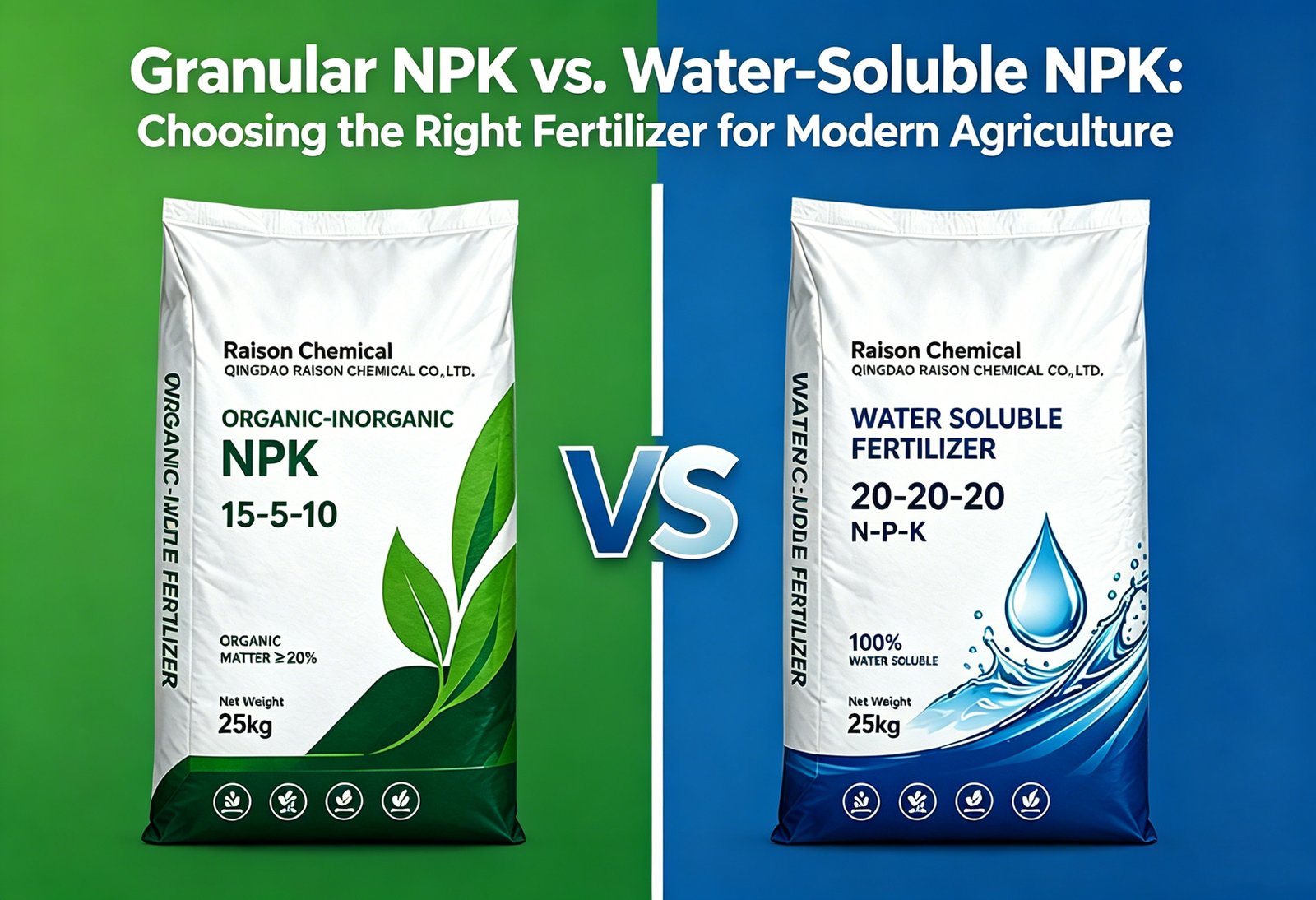
In the pursuit of higher yields and smarter resource management, selecting the right NPK formulation is no longer just about N-P-K ratios—it’s about physical form, solubility, and application efficiency.
For distributors, formulators, and large-scale growers, understanding the distinction between Granular NPK and Water-Soluble NPK is critical. While both provide the essential macronutrients—Nitrogen (N), Phosphorus (P), and Potassium (K)—their physical properties dictate vastly different use cases, economic outcomes, and ROI.
This article breaks down the technical differences to help you optimize your procurement and application strategies.
1. Granular NPK: The Backbone of Field Agriculture
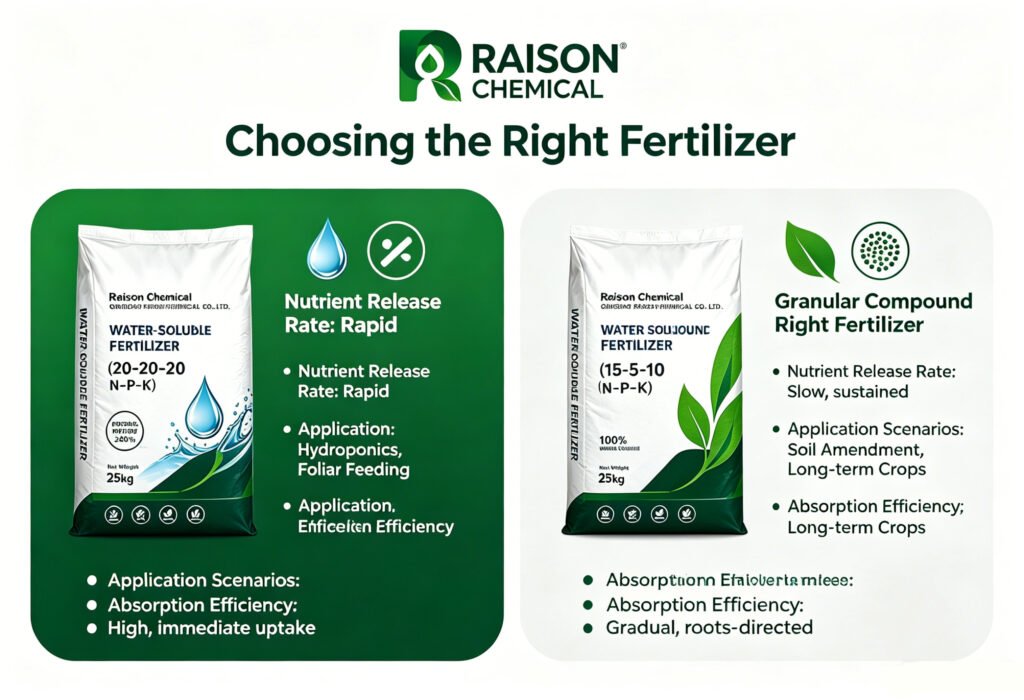
Granular fertilizers are the traditional workhorses of agriculture. Produced via methods like rotary drum granulation or extrusion, these solid pellets are designed for slow release and ease of transport.
- Composition: Typically contains macro-nutrients. May include fillers, anti-caking agents, and secondary nutrients (like Sulfur or Magnesium).
- Solubility: Partial. Designed to dissolve slowly in soil moisture to provide a steady nutrient supply over weeks or months.
- Application: Primarily broadcasting (spreading over soil) or side-dressing.
- Best For: Large-acreage field crops such as Corn, Wheat, Soybeans, and Rice.
- Advantages:
- Cost-Effective: Lower production cost per unit of nutrient.
- Logistics: High bulk density, easy to store, and compatible with standard spreader equipment.
- Longevity: Reduces nutrient leaching due to slower release profiles.
2. Water-Soluble NPK: Precision Nutrition for High-Value Crops
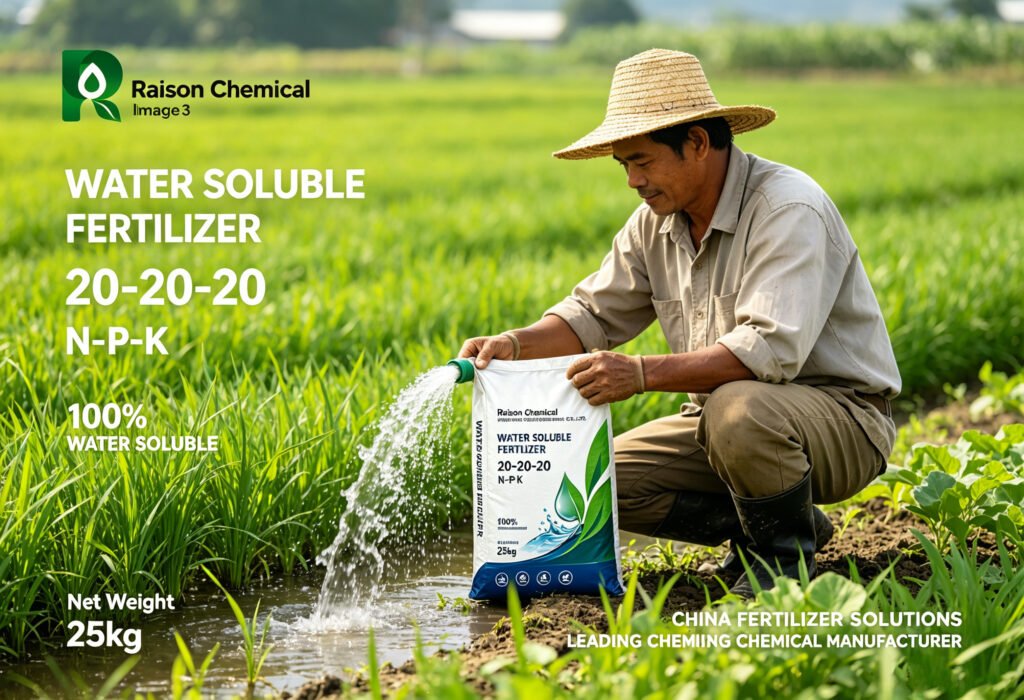
Water-soluble fertilizers (WSF) represent the premium segment of the market. These powders or crystals are engineered for 100% solubility, leaving virtually no residue.
- Composition: Highly purified raw materials (often sourced from Industrial Grade phosphates/nitrates). Low heavy-metal content. Contains chelated micronutrients (Fe, Mn, Zn, Cu) for immediate uptake.
- Solubility: Complete. Dissolves instantly in water without sedimentation.
- Application: Fertigation (through drip irrigation) and Foliar Spray.
- Best For: High-value horticulture, Greenhouses, Orchards, Vineyards, and Hydroponics.
- Advantages:
- Efficiency: Nutrients are immediately available to the root zone or leaves (Foliar feeding bypasses soil fixation).
- Precision: Allows for exact control over EC/pH levels in hydroponic systems.
- Cleanliness: Prevents clogging of drip emitters and sprinkler nozzles.
3. Head-to-Head Comparison
| Feature | Granular NPK | Water-Soluble NPK |
|---|---|---|
| Physical State | Solid Pellets | Fine Powder / Crystals |
| Solubility | Slow / Partial | Instant / 100% |
| Primary Method | Broadcasting / Basal | Fertigation / Foliar |
| Nutrient Uptake | Soil-dependent | Direct & Rapid |
| Equipment Needed | Spinner Spreaders | Irrigation Systems / Sprayers |
| Cost per Ton | Low | High |
| Labor Intensity | Low | Higher (mixing/monitoring) |
| Risk of Burn | Lower (if applied correctly) | Higher (requires dilution control) |
4. Application Scenarios: Where Each Excels
Scenario A: Open Field Cereals (Use Granular)
A farmer managing 500 hectares of wheat cannot feasibly mix tons of powder daily. Here, Granular NPK is applied during land preparation or as a top-dress. The goal is to sustain the crop over its long lifecycle with minimal labor input.
Scenario B: Greenhouse Vegetables (Use Water-Soluble)
A tomato grower in a greenhouse uses drip lines. Applying granular fertilizer would require manual labor to place near each plant and risks uneven distribution. Using Water-Soluble NPK via fertigation ensures every plant receives the exact same nutrient dose with every watering, maximizing fruit size and uniformity.
Scenario C: Foliar Correction (Use Water-Soluble)
If a leaf analysis shows an acute Iron deficiency, broadcasting granular iron sulfate is ineffective because it becomes locked in the soil. A Water-Soluble chelated Iron spray provides immediate correction within 24–48 hours.
Granular NPK5. Common Procurement Pitfalls
- Using WSF for Broadcasting: This is extremely wasteful. The high cost of water-soluble raw materials does not translate to better results if simply scattered on the soil surface; rain will wash it away before the plant can use it.
- Impurities in Irrigation Systems: Never use standard industrial or agricultural-grade powders in fertigation unless labeled “Water Soluble.” Insoluble impurities will clog drip tapes, leading to costly system failures.
- Ignoring the Salt Index: High concentrations of certain granular fertilizers can increase soil salinity. Conversely, mismanaging WSF concentration can cause root burn (“fertilizer burn”) due to osmotic pressure.
6. The Raison Chemical Perspective
The shift toward sustainable agriculture means the line between these two products is evolving. While Granular NPK remains king for global food security due to its scalability, the demand for Water-Soluble NPK is growing at nearly double the rate, driven by water scarcity and the need for precision farming.
At Raison Chemical, we supply both high-quality Granular NPK blends for broad-acre applications and the high-purity raw materials required for manufacturing premium Water-Soluble Fertilizers. Understanding your crop’s phenology and your infrastructure capabilities is the key to choosing between these two powerful tools.
Looking for a reliable source for NPK raw materials or customized blends?
Contact the Raison Chemical technical team to discuss how our supply chain solutions can support your agricultural projects.
📧 Email: [laxenrschemical@gmail.com]
🌐 Website: [raisonchemical.com]