Maximizing paddy yield isn’t about applying more fertilizer—it’s about applying the right nutrients at the precise physiological stage. Here is the definitive roadmap for rice fertility management.
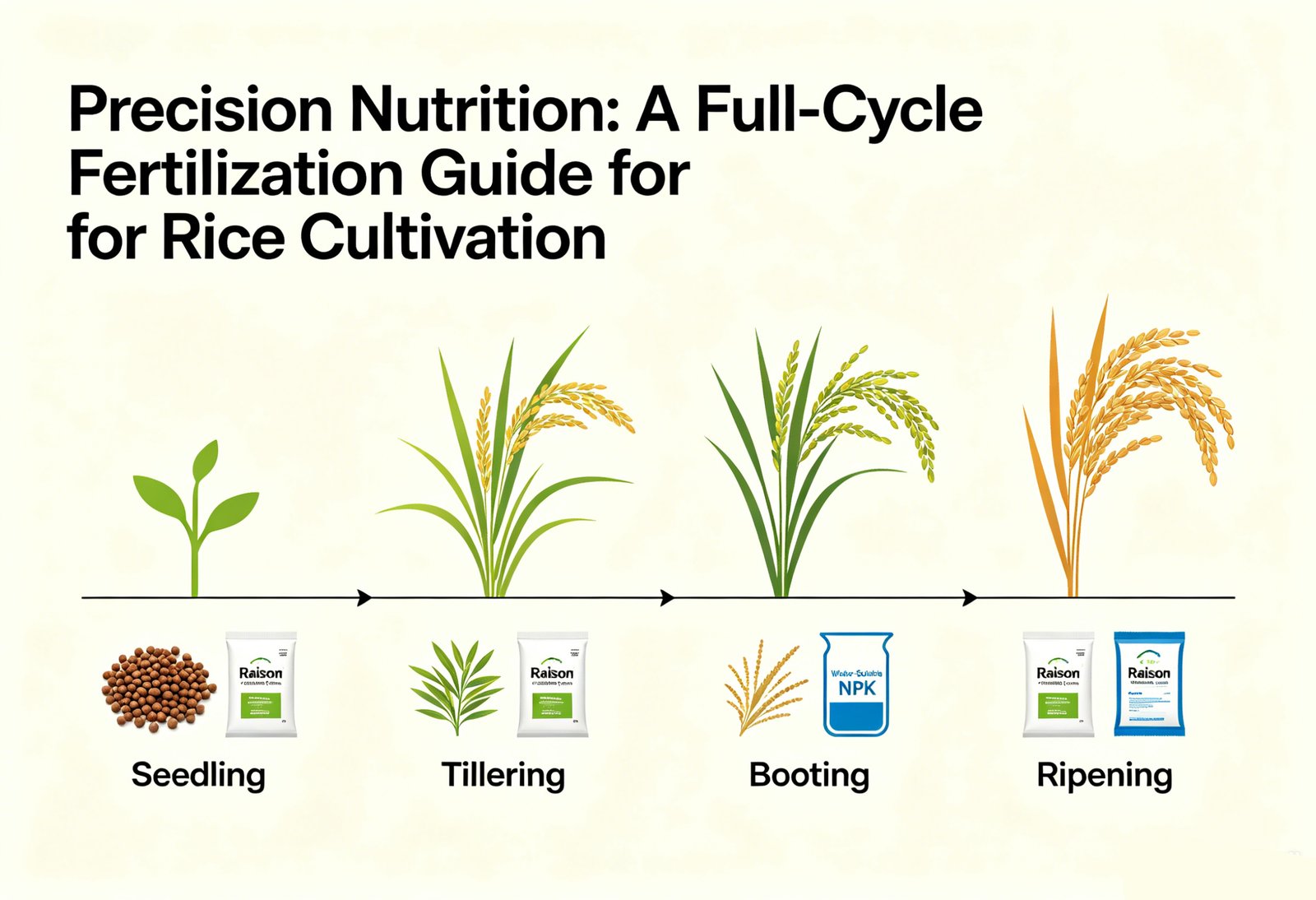
Rice (Oryza sativa) is one of the most nutrient-sensitive staple crops globally. A generic “apply and pray” approach leads to wasted resources, environmental runoff, and sub-optimal yields. To achieve high productivity and grain quality, growers must align their fertilization strategy with the plant’s distinct growth stages: Tillering, Panicle Initiation, and Grain Filling.
This guide provides a technical framework for a full-cycle rice fertilization program, balancing Granular NPK for basal stability and Water-Soluble NPK for critical top-dressing efficiency.
Stage 1: Basal Application (Pre-Planting / Transplanting)
Objective: Promote early root establishment and vigorous seedling growth.
Before transplanting or direct seeding, the soil requires a foundation of nutrients. This is the time for slow-release sources.
- Recommended Formula: Granular NPK (12-12-17 or similar complex blend) + Organic Matter.
- Application Strategy:
- Incorporate fertilizer into the soil 2–3 days before transplanting.
- Apply 40–50% of the total Nitrogen budget here.
- Ensure adequate Zinc (Zn) application if soil tests indicate deficiency (common in high-pH soils), as Zinc is crucial for tillering.
- Why Granular? At this stage, the roots are shallow. Granular fertilizers release nutrients slowly, matching the initial low uptake rate and preventing leaching during flooding.
Stage 2: Early Tillering Phase (Active Growth)
Objective: Maximize effective tiller count (the number of stalks that will bear grain).
Approximately 7–10 days after transplanting, the plant enters the tillering phase. Nitrogen demand spikes.
- Recommended Formula: High-Nitrogen Water-Soluble NPK (e.g., 30-10-10 or 20-20-20).
- Application Strategy:
- Apply via Fertigation or Foliar Spray.
- Apply 20–25% of the total Nitrogen budget.
- Maintain a shallow water level (2–3 cm) to facilitate nutrient absorption.
- Technical Insight: Using Water-Soluble NPK here allows for rapid green-up. Foliar application can correct hidden hunger symptoms immediately, ensuring no tillers are lost due to nutrient stress.
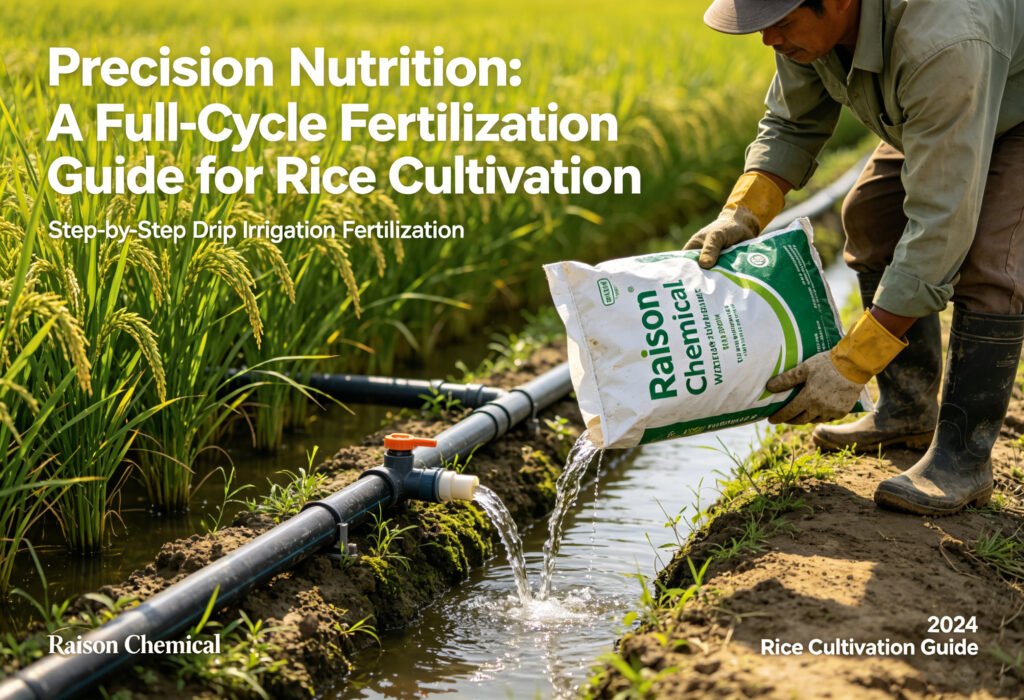
Stage 3: Panicle Initiation (The Critical Stage)
Objective: Develop a large, well-filled panicle (the “head” of grain).
This occurs roughly 40–50 days after transplanting. This is the most critical fertilization window. The plant requires a massive influx of Potassium and Phosphorus to support reproductive growth.
- Recommended Formula: Low Nitrogen, High Potassium Water-Soluble NPK (e.g., 10-20-30 or 15-15-30).
- Application Strategy:
- Apply 20% of the total Nitrogen budget.
- Apply 50–60% of the total Potassium budget.
- This is often called the “Panicle Fertilizer.”
- Warning: Excess Nitrogen at this stage leads to “lazy rice” (lodging), where tall, weak stalks fall over, ruining the harvest. Potassium strengthens cell walls and improves disease resistance.
Stage 4: Heading & Grain Filling (Ripening)
Objective: Increase grain weight (1000-grain weight) and starch accumulation.
Once the panicles have emerged, the focus shifts from vegetative growth to grain development.
- Recommended Formula: Potassium Nitrate or specialized Ripening formulas.
- Application Strategy:
- Apply the remaining 10–15% of Nitrogen and Potassium.
- Switch to Foliar Feeding exclusively if the crop is close to maturity to avoid burning the leaves with soil salts.
- Pro Tip: Adding Silica (Si) at this stage significantly enhances stem strength and reduces vulnerability to pests like the Brown Plant Hopper.
Comparative Summary: Nutrient Allocation by Stage
| Growth Stage | Timing (DAT*) | Primary Goal | Recommended NPK Type | Key Nutrient Focus |
|---|---|---|---|---|
| Basal | -3 to 0 | Rooting | Granular | N, P, Zn |
| Tillering | 7–15 | Leaf/Stalk Count | Water-Soluble | N |
| Panicle Init. | 40–50 | Head Size | Water-Soluble | K, P |
| Grain Filling | 70–85 | Yield/Weight | Foliar (WSF) | K, Si |
*DAT: Days After Transplanting
Special Considerations for Different Farming Models
- Direct Seeding: Requires a higher proportion of starter fertilizer (starter dose) immediately after sowing compared to transplanted rice.
- System of Rice Intensification (SRI): Relies heavily on intermittent wetting and drying. Water-Soluble fertilizers are mandatory here to prevent losses during drainage cycles.
- Arid Regions (e.g., California/North China): Drip irrigation systems necessitate 100% Water-Soluble NPK throughout the cycle to maintain precise EC levels in the root zone.
Common Mistakes to Avoid
- The “Front-Loading” Trap: Applying too much Nitrogen early causes excessive vegetative growth, shading lower leaves, and reducing tiller survival.
- Ignoring Potassium: Many farmers focus solely on Nitrogen. Potassium deficiency results in poor grain filling, even if the plant looks green.
- Late Nitrogen: Applying Nitrogen too close to harvest delays maturity and lowers milling quality (more chalky grains).
Raison Chemical: Supporting Your Rice Program
Successful rice cultivation requires a flexible nutrient toolkit. Raison Chemical supplies both the high-quality Granular NPK blends required for robust basal dressing and the ultra-pure Water-Soluble grades necessary for precision fertigation and foliar programs.
By synchronizing your nutrient supply with the rice phenology, you don’t just grow rice—you engineer a harvest.
Need customized NPK formulations for your specific soil type or climate?
Consult with the Raison Chemical technical team for tailored solutions.
📧 Email: [laxenrschemical@gmail.com]
🌐 Website: [raisonchemical.com]